
How Steadyrack’s Premium Rack Overtook Its Entire Classic Range in Six Months
Steadyrack sells wall-mounted vertical bike racks across the world from Perth. They came to us with rising acquisition costs, customers getting confused when buying the premium product, and no structured way to test. Six months in: 11 winners from 27 completed tests, and a key lever to unlocking sales on their premium product
The problem they came with
Customer acquisition costs were rising, especially in the US. Most Steadyrack customers buy once, so every first order has to be profitable on its own.
In their words, the product on the page was the other half of the problem. People can be very overwhelmed with a technical product, and the job is finding the line between giving the consumer too much and not giving them enough. Meanwhile there was no structured way to test website changes.
Three Shopify Plus stores, earning less per visitor than benchmarks. At that kind of volume, a small lift in revenue per visitor pays for itself quickly. The brief was a proper testing program with the research to back it, not best-practice guesses.
Where the sales were leaking
Before the program, a visit that began on the ProFlex product page was worth less than half a visit that began on the cheaper Classic MTB page. In their own sales data, the premium rack’s page was the weakest rack page on the site despite being the newest and best product.
And the Funnel said the same thing.
Ninety-six of every hundred visitors left without putting anything in the cart at all. People arrived, looked, and could not decide.
Before the program
What a visit to each page was worth
- Classic MTB PDP100
- Classic Road PDP94
- Homepage82
- ProFlex PDP45
What the research showed
Surveys, heatmaps, session recordings, support tickets, mined reviews and the funnel itself all converged on the same confusion: which rack do I need?
Seventeen percent of support tickets were sizing questions, people asking the business what the website should have answered. Eighty percent of returns came from people who had been confused about sizing and space. Session recordings and user tests showed size buttons being ignored on the collection page, with add-to-cart possible without making a choice about sizing.
“Which rack do I need?”
The same question, in every survey we ran
Share of responses describing product-selection confusion, by question asked. On-site and email surveys, Jan to Mar 2026.
Key insight: Product selection is the one friction that shows up no matter how the question is phrased. It is the single biggest addressable problem in the dataset, and it is a comprehension problem, not a trust or a price problem. Supporting it: 17% of support tickets are sizing questions and 80% of returns trace to fit and space.
The solution: name the bike, not the rack
The ProFlex range came in three variants named Narrow, Wide and Fat. Those are brand names that describe the rack, not the bike. To find out which one fitted their bike, a buyer had to click through to a separate page, which only about 5% of users did.
Every test that won put the answer in the buyer’s own language, without asking them to do anything: which bike you ride, which rack you need. We tested that idea on the collection page, the product page, the filters, the cart drawer and the homepage. All five came back as a win.
Splitting ProFlex into three bike-type products on the collection page (instead of just one SKU) changed the product mix and lifted ProFlex orders 28 percent. A “best suited for” line above the variant selector lifted ProFlex conversion 24 percent. Bike-type filter buttons lifted conversion 8 percent and revenue per visitor 10 percent. Repeating the same line in the cart drawer lifted conversion 8.7 percent. Splitting the racks out in the homepage best sellers lifted it 9.6 percent.
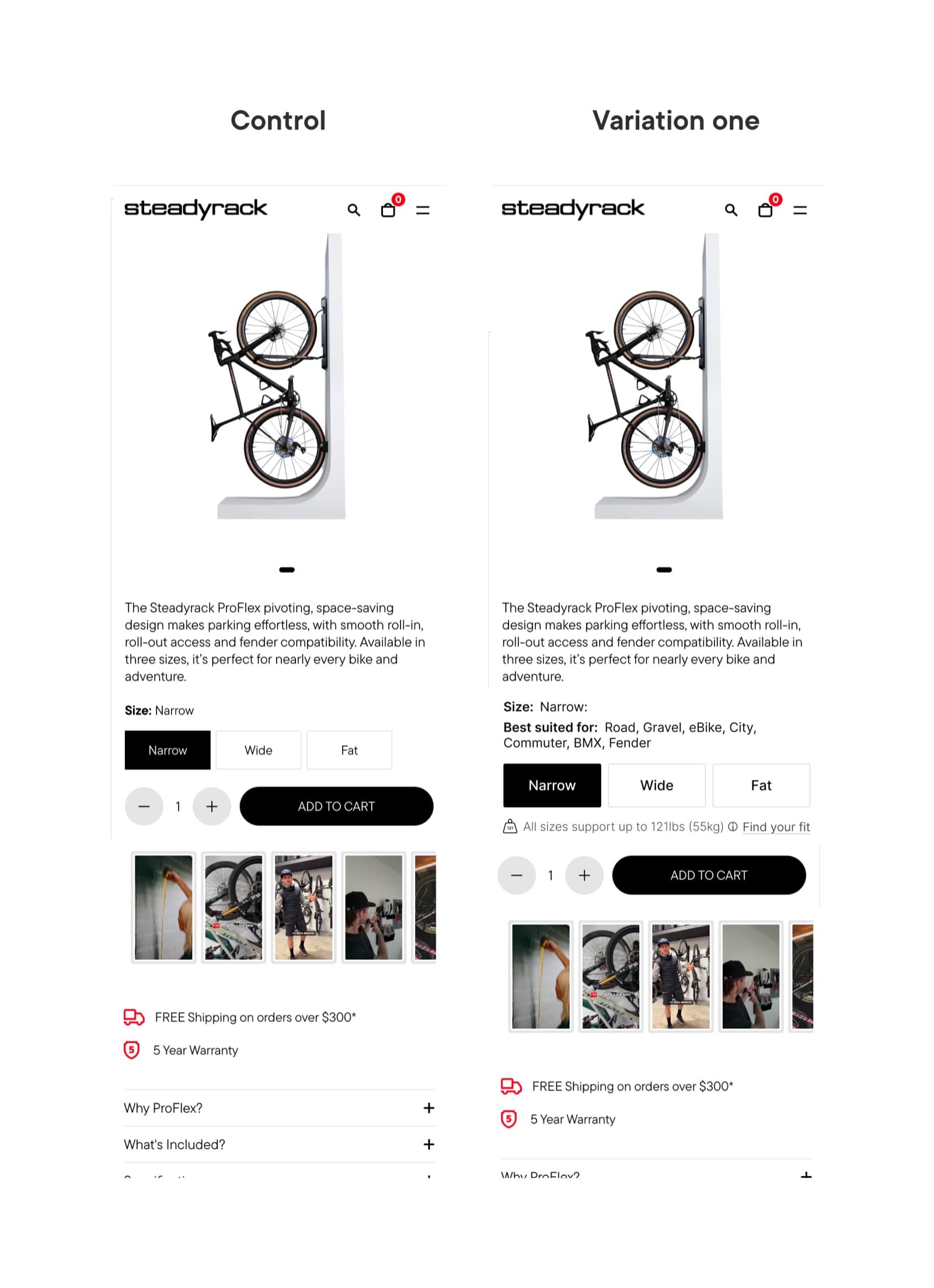
The wins, side by side
Click any card to see the control and the variation side by side.
What didn’t work
Detail overwhelmed the customer. People exited buying mode, and went into analysis mode. A modal that asked buyers to measure their tyre lost, and lost badly. Have the detail available for anyone who goes looking, but keep it off the page where the decision happens.
Trust surprisingly turned out not to be a lever here. Steadyrack has sold over 1 million racks worldwide and the brand carries that weight already. Repeated attempts to add trust signals did nothing, and sometimes did worse than nothing.
Eleven of the 27 tests we completed produced a winner worth shipping. The other sixteen either lost or came back flat, but both are cheaper than publishing a guess and finding out later.
What changed in what people bought
What changed was which rack people picked, and that is what the tests were built to do.
The cleanest measure is the premium rack’s share of rack units across the whole lineup, with the two discontinued Classic models stripped out of both years. In the six months before the program ProFlex was 46.9 percent of rack units, behind the Classic range. In the six months of the program it reached 50.7 percent, overtaking the entire Classic range. Month by month the shift lands when the first test rolled out on 24 April: every month after it sits above every month before, bar the June mid-year sale, and August is the highest in the series at 57.3 percent.
Category-wide, discontinued models excluded
The premium rack overtook the entire Classic range
- 48.4Jan
- 49.2Feb
- 47.3Mar
- 47.9Apr
- 54.9May
- 47.3Jun
- 53.3Jul
- 57.3Aug
What the programme is worth
We do not annualise every winning test and call that our result. Each winner is weighted by that page’s share of site orders, annualised, then corrected for seasonality and for results that got statistically lucky, using the standard winner’s-curse correction.
On that basis, the wins shipped in the first six months are worth a 10x return on the investment in the program in annual run rate basis. This is based on North American visits only, and the wins have since been hardcoded across all three markets.
What’s next?
The biggest lever so far has been unblocking: making it easier to work out what to buy. That finding is tested and locked in, and there are still more tests to come.
The next phase moves from unblocking buyers to motivating them. Pricing and elasticity, economics, bundling and order value, and the messaging that makes someone want the premium rack rather than merely understand it. That work can affect more than just the landing page: the same answers that feed the product pages, also can influence the ads, the landing pages, and the markets where comprehension was never the problem.
The end goal is a repeatable testing engine, so that every new product launch gets the same research-led treatment the racks got.
What actually moved
- The same fix tested on five separate surfaces and came back positive on all five.
- Collection page bike-type split lifted premium-rack orders 28% at 98% confidence.
- "Best suited for" labelling lifted premium-rack conversion 24%.
- 11 winners from 27 completed tests, with every loss written into the rules the next test obeys.
- The premium rack overtook the entire Classic range, from 46.9% to 50.7% of rack units over the six-month program, with the discontinued models excluded from both years.
Other programs, other results.
Let's move your revenue with the Impact Conversion Method.
Give us fifteen minutes together, and we'll tell you straight whether we are a fit, with no slide deck or sales script in the way.
Not ready to book? Send us your details and we'll come back by email.