
Copywriting · November 2026
The five stages of awareness: the one idea behind everything we do in CRO
Most landing pages don't fail because of the button colour. They fail because they're talking to the wrong person.
Perhaps a discount code shoved in front of someone who's never heard of you. A massive "problem" section for someone who already has their card out. Same page, same offer, completely wrong conversation.
Eugene Schwartz worked this out back in 1966, in his book Breakthrough Advertising. He called it the five stages of awareness, and it's fundamental to everything we do in CRO. Before we write a hypothesis, brief a landing page or test a headline, we ask one question first:
How much does this person already know?
Why this matters
You might have noticed: ads aren't getting any cheaper. So everyone's chasing new hooks, new creators and the latest viral format. Meanwhile the click lands on a page that pitches every visitor the exact same way, whether they found you through a cold Reel or typed your brand name into Google.
Those are two completely different people. One needs convincing that the problem is real. The other just wants the price and the buy button. Give them the same page and you lose one of them, every time.
But, if you get the stage right and the same traffic turns into more buyers.
How the stages work
Schwartz's big idea is that copy can't create desire.
The desire is already out there. Your job is to point it at your product, and you can only do that if you stand exactly in the readers shoes.
So he sorted people by how much they understand two things: the result they want, and your product as the way to get it. The more they know, the less you need to say. The less they know, the more work the page has to do before it can even mention the product.
He also said there's a wall between each stage. A headline that works brilliantly for one stage means nothing to the next. His example was soap. A headline that just says the brand and the price ("Dial Soap, 9c a cake") works on people who already want Dial. Show it to someone who doesn't know a soap can have a deodorant built in, and they turn the page without a second look.
Schwartz starts at the top (most aware) and works down. These are the Five Stages of Awareness.
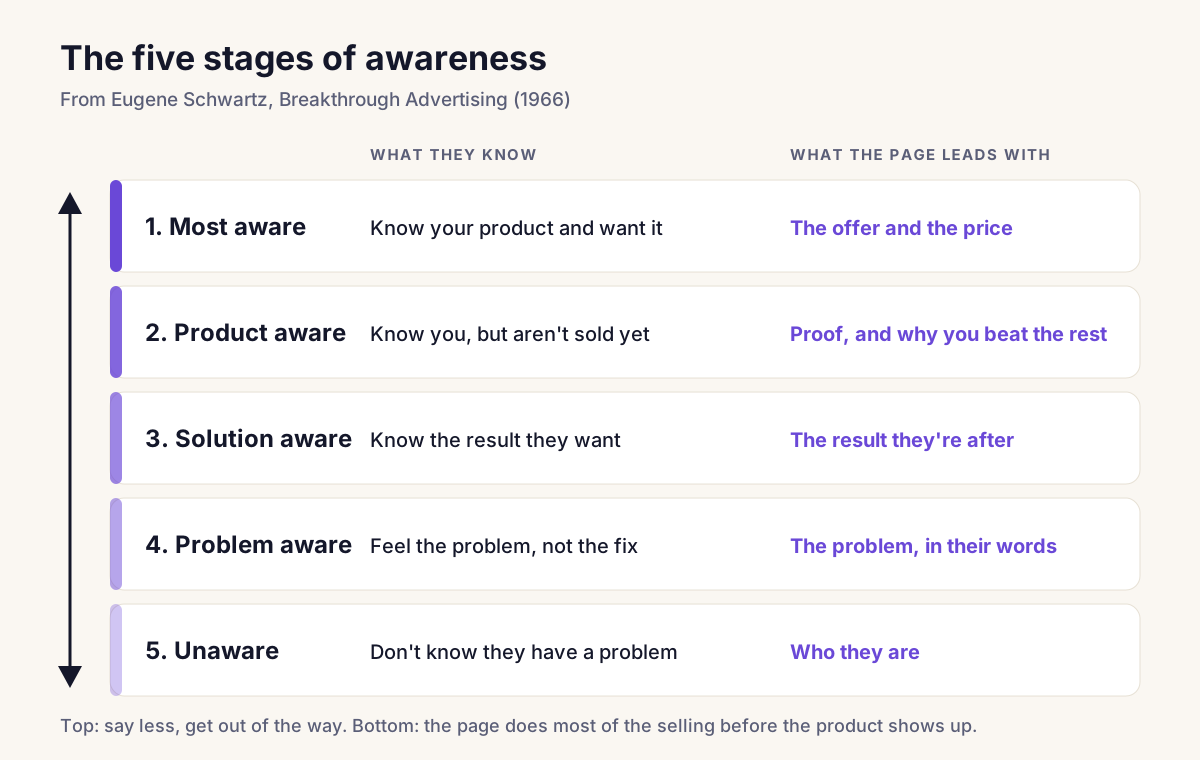
1. Most aware
They know the product, know what it does and want it. They just haven't bought yet.
Schwartz said the copy here needs little more than the product name and a reason to buy now. Maybe the price, a gift, or fast shipping. He called this the least creative job in advertising, and he wasn't being nice about it either.
These are returning visitors, the branded search, the people in your abandon cart flows. They don't need persuading. They need a clear price, the offer front and centre and a buy button they can't miss. Don't make them scroll past your life story to find it.
2. Product aware
This stage knows you. They just don't want you yet. They aren't sure it works as well as you say, or they haven't heard what's new.
Schwartz said most advertising lives here. Your name does some of the work, but the copy does the rest. It builds the desire, sharpens the picture of the outcome, adds new proof, or explains why your version works better than the others.
On your site, this is the comparison shopper with three tabs open. They know you, and they know your competitors. They want reviews, a guarantee, a clear reason you beat the other option and an answer to "will this work for me?". Product pages for this visitor live or die on proof.
Open your product page and your top competitor's side by side. If a shopper can't tell why yours is better in ten seconds, try change that first.
3. Solution aware
These customers know the result they want. But they don't know your product delivers it.
Schwartz lays out three steps for this stage. Say you sell a weighted blanket:
- Name the result in the headline. E.g. "Finally sleep through the night, without the pills."
- Prove it can be done. E.g. reviews from people who used to lie awake until 2am, and now don't.
- Show that the thing making it work is built into your product. Explain why it works, then show that's exactly what your product does. E.g. even, gentle pressure across your whole body helps you settle, and that's what the blanket is designed to give you all night.
This is typically cold traffic from an ad that promised an outcome. E.g an ad that said "Finally sleep through the night." They clicked because they want the result, not because they know your brand. If the page opens on your logo and a spec sheet, you've lost them. Lead with the outcome they clicked for, then show them how your product gets them there.
Read your ad, then read your hero. If the hero doesn't repeat the promise the ad made, then fix that first.
4. Problem aware
They feel the problem. The Symptoms. They just haven't connected it to a solution like yours.
Schwartz's formula here is simple, name the problem in the headline. Make them feel how badly they want it fixed. Then show your product as the obvious answer. Sometimes the headline is nothing but the problem. His example is one word: "Corns?" As in the painful lumps on your feet. Anyone with a corn stops and reads. Everyone else turns the page, and that's fine, because they were never going to buy a corn remover.
These are the people searching their symptom, not your category. The page earns the right to sell by describing their situation better than they could. And the best place to find that language isn't in your "brand personas". It's your reviews, surveys and support tickets, in your customers' own words. (Here's how we find it.)
5. Unaware
They don't know they have the problem. Or they do, but won't admit it. Or it's too vague to put into words.
This is the hardest stage, and in the book, Schwartz starts with what you definitely shouldn't write.. No price, because it means nothing to someone who isn't even aware of the problem.
Same applies to the product name, don't mention that. And hardest of all, don't write a straight statement of what the product does.
So what's left?
The reader. The headline tells them who they are, so they recognise themselves and keep reading. It doesn't sell the product. The job of the headline is to get someone to keep reading the line below it.
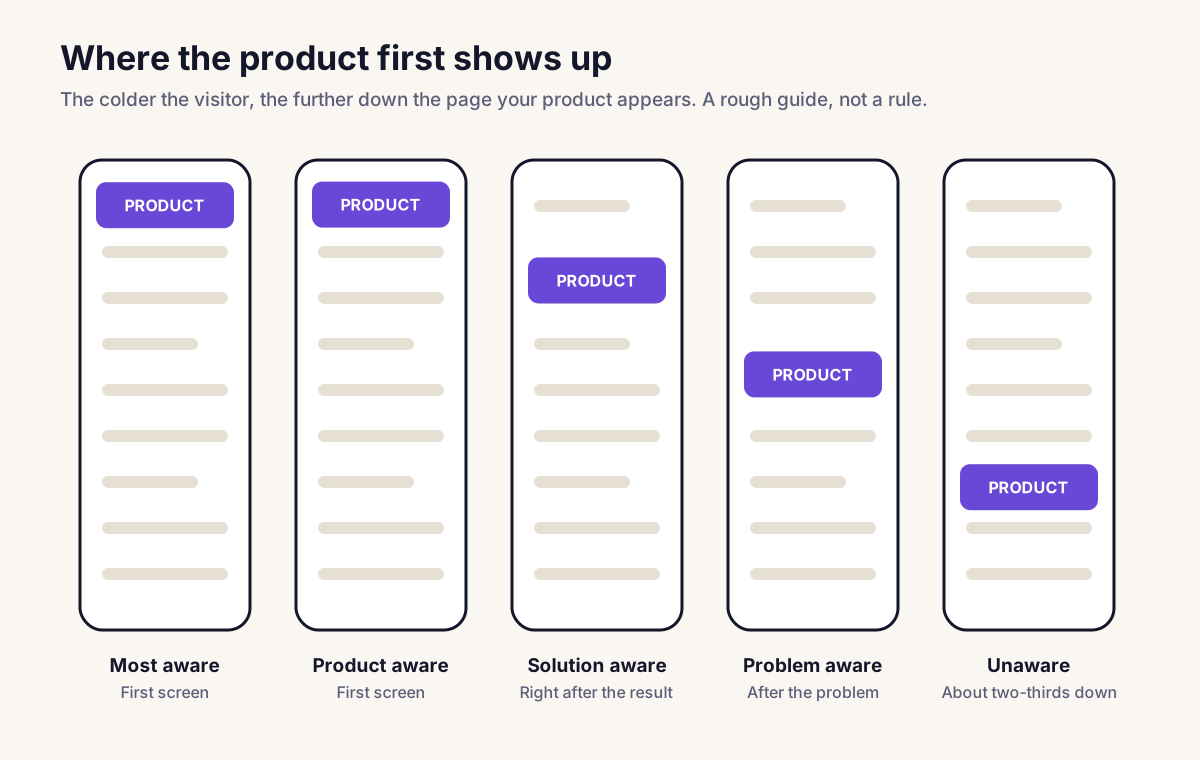
On your site, this is broad cold traffic and your landing page looks like advertorials and listicles. These pages read like an article or a story, not a sales page, and the product shows up much later. Because It has to. The page needs to walk them through every stage above this one before an offer makes any sense.
Why this is behind every test we run
When a page underperforms, most teams start tweaking buttons, colours and hero images. Most of the time the real problem is simpler: the page is talking to the wrong person.
That's why awareness comes first for us:
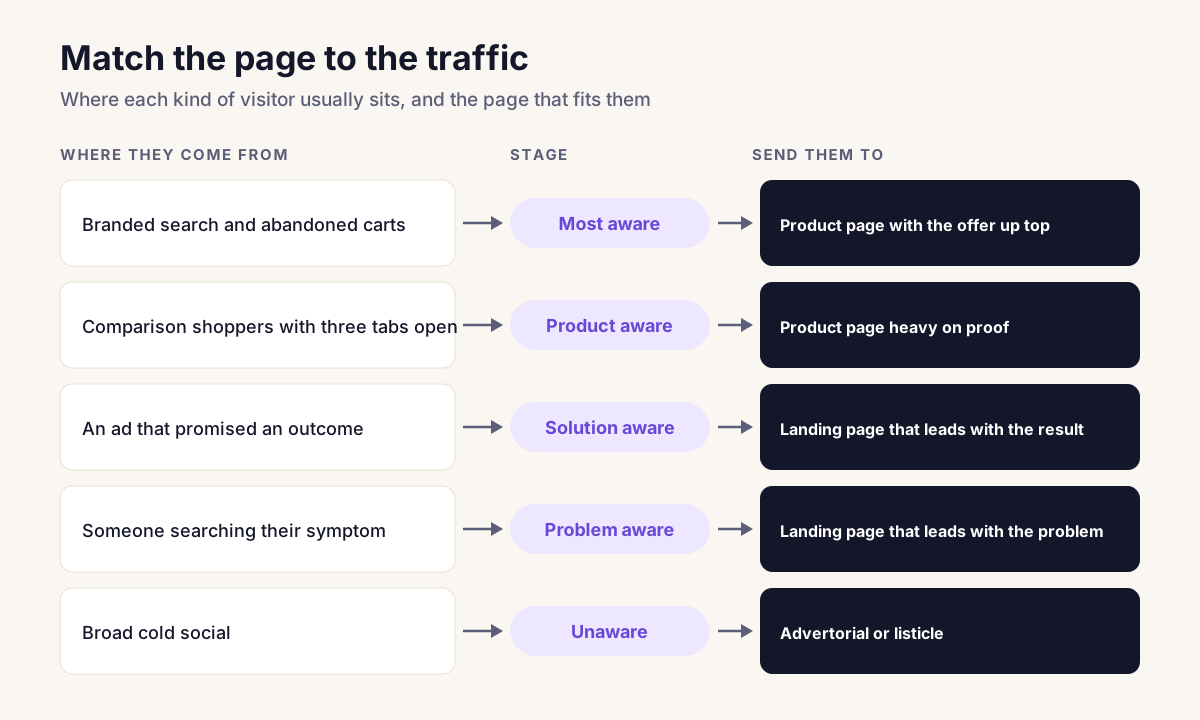
- We look at the traffic before we touch the page. Branded search and retargeting are usually most aware or product aware. Cold paid social is usually solution aware or lower.
- Every hypothesis names the stage. "Problem-aware visitors from this ad set bounce because the page opens on the product" is something you can test. "Make the hero stronger" isn't.
- Headline tests change the starting point. A product-led headline against a problem-led one tells you far more than two versions of the same promise.
- Research gives us the language to use. The colder the visitor, the more you need their exact words to reach them.
If you want to see what a page looks like at each stage, we broke down 165 of the top D2C landing pages, and the free landing page guide shows how we build a page for each one.
The short version
Work out how much your visitor knows, then start exactly there.
Say too much to someone ready to buy and you slow them down. Say too little to someone who's never heard of you and they never reach the offer. Schwartz figured this out for print ads 60 years ago, and it still decides whether your landing page converts.
Questions people ask
What are the five stages of awareness? Most aware, product aware, solution aware, problem aware and unaware. They describe how much someone already knows about the result they want, and about your product as the way to get it.
Who came up with the five stages of awareness? Eugene Schwartz, in Breakthrough Advertising (1966). He described each stage in full sentences. The short labels most marketers use now came later.
How do I use them on a landing page? Work out which stage your traffic is in before you write a word. Then lead with what that stage needs: the offer, the proof, the result, the problem, or the reader themselves.
If your pages pitch every visitor the same way, here's how we work. Or book a 15-minute call and I'll tell you which stage your biggest-spend traffic is in, and whether your page is talking to it.